How many fish can I put in my tank?
Enter your tank size and the fish you want: the calculator estimates the bioload and checks compatibility (temperature, pH, group size, behaviour).
Not sure of the volume? Calculate it from the dimensions.
All tools and guides
Most popular species
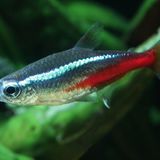 Neon tetrafrom 14 gal / 54 L
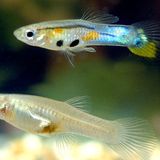 Guppyfrom 11 gal / 40 L
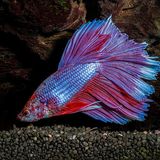 Betta (Siamese fighting fish)from 11 gal / 40 L
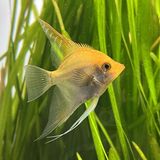 Angelfishfrom 53 gal / 200 L
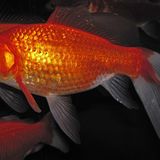 Goldfishfrom 40 gal / 150 L
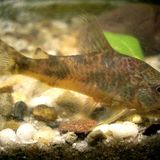 Peppered coryfrom 18 gal / 70 L
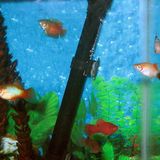 Platyfrom 14 gal / 54 L
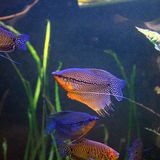 Pearl gouramifrom 21 gal / 80 L
Guides by tank size
Stocking ideas and suitable species, size by size:
5 gal10 gal15 gal20 gal29 gal40 gal55 gal75 gal90 gal125 gal
Can they live together?
Tank mate answers for popular pairs, checked against water ranges and behaviour:
Guppies + Neon TetrasBettas + GuppiesBettas + Neon TetrasAngelfish + Neon TetrasAngelfish + GuppiesGoldfish + GuppiesGoldfish + BettasBettas + Cherry ShrimpGuppies + Cherry ShrimpGuppies + MolliesGuppies + PlatiesMollies + PlatiesBettas + CorydorasNeon Tetras + CorydorasGuppies + CorydorasTiger Barbs + Angelfish
How the calculation works
The old "one inch of fish per gallon" rule underestimates large fish: a fish twice as long eats and produces far more than twice as much waste. Conversely, a formula based on body volume (length³) suggests you could keep dozens of micro fish in a small tank. We therefore use a compromise, calibrated on the usual recommendations of experienced fishkeepers (about 15 to 20 neon tetras in 16 gallons, 4 to 5 angelfish in 53 gallons):
litres of real water per fish ≈ adult length in cm² ÷ 8 (at least 1 L)
In US units that is roughly 0.21 × (adult length in inches)² gallons of real water per fish. Examples: a 1.6 in (4 cm) neon tetra takes about 0.5 gallon (2 L), a 2.4 in (6 cm) platy about 1.2 gallons (4.5 L), a 6 in (15 cm) angelfish about 7.4 gallons (28 L). Up to 80% of the net volume, the bioload is comfortable; between 80 and 110% it is high and needs good filtration; beyond that, the tank is overstocked.
The net volume is estimated at 80% of the gross volume, because substrate, decor and equipment take up space. For each species we also check the minimum tank size, the group size, the temperature and pH ranges, and known incompatibilities (fin nippers, predators of small species…).
The species profiles (temperature, pH, group size, minimum tank) are checked against Seriously Fish, a reference database for fishkeepers.
These numbers are guidelines: good filtration, regular water changes and watching your fish matter as much as the calculation.