Marbled hatchetfish: minimum tank size, how many and tank mates
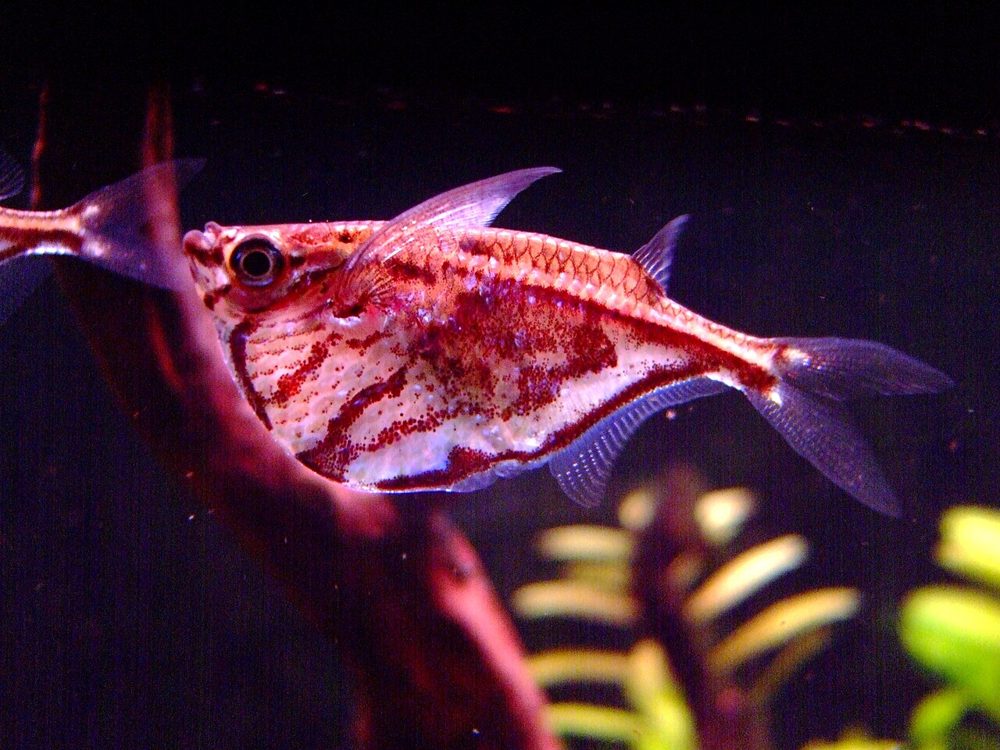
An excellent jumper: a tight-fitting lid is essential.
Quick facts
Marbled hatchetfish: how many per tank?
Maximum recommended number if it is the only species in the tank (comfortable bioload of 75%). Below 18 gal / 70 L, this species is not recommended.
In practice
A 20-gallon (76 L) tank holds about 16 gal / 61 L of real water: up to 29 can live in it if this is the only species, or 16 if you leave room for other fish.
As it lives in groups of at least 10, you need at least 10 of them anyway, so a tank of 18 gal / 70 L or more.
Best tank mates
Compatible species (temperature, pH and behaviour) that mostly live in another zone of the tank: they share the space instead of getting in each other's way.
 Black phantom tetraMiddle · 72–82 °F / 22–28 °C in common
 Lemon tetraMiddle · 72–82 °F / 22–28 °C in common
 MollyMiddle · 72–82 °F / 22–28 °C in common
 OtocinclusBottom · 72–82 °F / 22–28 °C in common
 Harlequin rasboraMiddle · 72–82 °F / 22–28 °C in common
 Chili rasboraMiddle · 72–82 °F / 22–28 °C in common
Example tank with this species
20 gallons (76 L)
Calculated with the calculator's rules: 75% target bioload, minimum group sizes respected, no compatibility warning.
- 10 Marbled hatchetfish
- 8 Black phantom tetra
- 6 Otocinclus
Equipment for a 18-gallon (70 L) tank (the minimum for this species)
- Heater essential (72–82 °F / 22–28 °C: a room at 68 °F / 20 °C is too cold): 75 W in a heated room, 100 W in a cold room.
- Filter: a flow of 55 to 90 GPH (210–350 L/h, 3 to 5 times the volume per hour).
- Electricity: about $4.80 a month for the heater, filter and lights (at an indicative $0.17/kWh).
Compatibility with other species
Compared with the 52 other species in our database: temperature, pH and behaviour. Also check that your tank is big enough for each of them.
✅ Compatible (47)
Betta (Siamese fighting fish)Black phantom tetraBlack skirt tetraBlue gouramiBoeseman's rainbowfishBolivian ramBristlenose plecoCardinal tetraCelestial pearl danioCherry barbCherry shrimpChili rasboraClown loachCockatoo dwarf cichlidCommon plecoCongo tetraDwarf gouramiEmber tetraEndler's livebearerGerman blue ramGlowlight tetraGreen neon tetraGuppyHarlequin rasboraHoney gouramiJulii coryKribensisKuhli loachLemon tetraLyretail killifishMollyNeon tetraOtocinclusPanda coryPearl danioPearl gouramiPeppered coryPlatyPygmy coryRed-tailed sharkRosy barbSerpae tetraSterba's corySwordtailTiger barbZebra danioZebra loach
⚠️ Avoid (5)
- Angelfish: Angelfish may eat Marbled hatchetfish
- Goldfish: Goldfish should live only with its own species
- Oscar: Oscar may eat Marbled hatchetfish; Oscar should live only with its own species
- White cloud mountain minnow: temperatures too different (57–72 °F (14–22 °C))
- Yellow lab cichlid: incompatible pH (7.7–8.6); Yellow lab cichlid should live only with its own species
Frequently asked questions
Marbled hatchetfish: how many in a 20-gallon tank?
Up to 29 if it is the only species in the tank (75% bioload). With other fish, keep fewer, but no fewer than 10.
Marbled hatchetfish: alone or in a group?
In a group of at least 10. Alone or in too small a group, the species is stressed and rarely shows itself.
Marbled hatchetfish: what temperature and pH?
Water at 72–82 °F / 22–28 °C and a pH of 4.5–7. A heater is essential.
Marbled hatchetfish and betta (Siamese fighting fish): compatible?
Yes: 72–82 °F / 22–28 °C and pH 6–7 in common, and no known behaviour conflict in our database. Make sure the tank holds at least 18 gal / 70 L.
Marbled hatchetfish and guppy: compatible?
Yes: 72–82 °F / 22–28 °C and pH 7 in common, and no known behaviour conflict in our database. Make sure the tank holds at least 18 gal / 70 L.