Rosy barb: minimum tank size, how many and tank mates
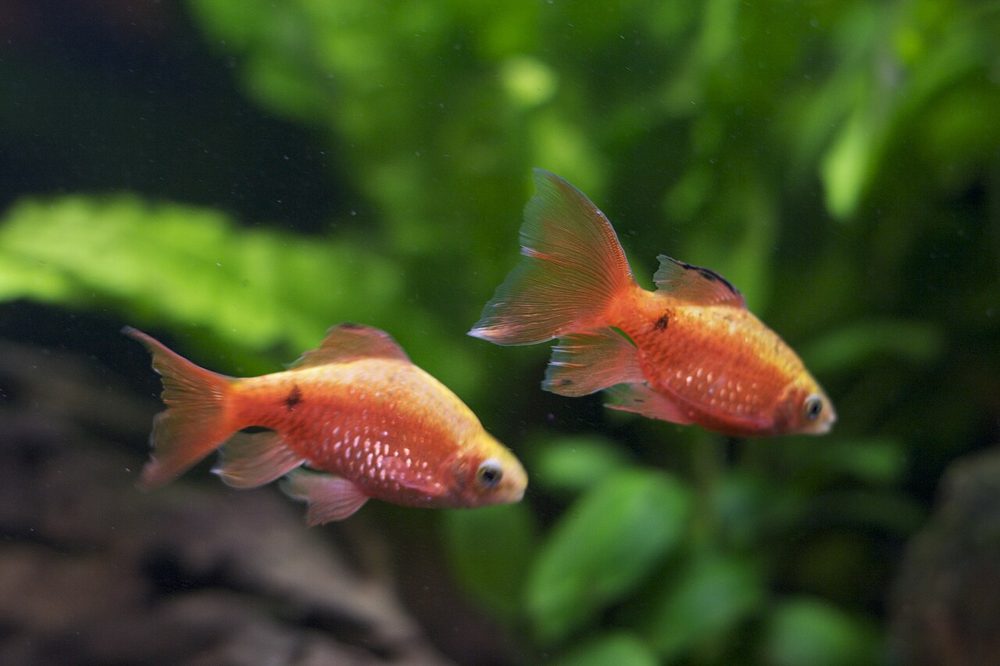
A hardy coolwater barb; in a small group it may harass long-finned fish.
Quick facts
Rosy barb: how many per tank?
Maximum recommended number if it is the only species in the tank (comfortable bioload of 75%). Below 24 gal / 90 L, this species is not recommended.
In practice
A 29-gallon (110 L) tank holds about 23 gal / 88 L of real water: up to 8 can live in it if this is the only species, or 8 if you leave room for other fish.
As it lives in groups of at least 8, you need at least 8 of them anyway, so a tank of 24 gal / 90 L or more.
Best tank mates
Compatible species (temperature, pH and behaviour) that mostly live in another zone of the tank: they share the space instead of getting in each other's way.
 Pearl danioTop · 61–75 °F / 16–24 °C in common
 Zebra danioTop · 64–75 °F / 18–24 °C in common
 Cherry shrimpBottom · 64–75 °F / 18–24 °C in common
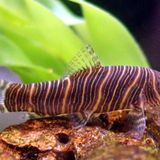 Zebra loachBottom · 70–75 °F / 21–24 °C in common
 Kuhli loachBottom · 70–75 °F / 21–24 °C in common
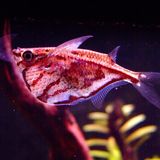 Marbled hatchetfishTop · 72–75 °F / 22–24 °C in common
Example tank with this species
55 gallons (208 L)
Calculated with the calculator's rules: 75% target bioload, minimum group sizes respected, no compatibility warning.
- 8 Rosy barb
- 8 Pearl danio
- 10 Cherry shrimp
Equipment for a 24-gallon (90 L) tank (the minimum for this species)
- No heater needed in a lived-in room: it is a coolwater species (61–75 °F / 16–24 °C), and a warm tropical tank does not suit it.
- Filter: a flow of 70 to 120 GPH (270–450 L/h, 3 to 5 times the volume per hour).
- Electricity: about $2.60 a month for the filter and lights (at an indicative $0.17/kWh).
Compatibility with other species
Compared with the 52 other species in our database: temperature, pH and behaviour. Also check that your tank is big enough for each of them.
✅ Compatible (32)
Black phantom tetraBlack skirt tetraBristlenose plecoCardinal tetraCelestial pearl danioCherry barbCherry shrimpChili rasboraCockatoo dwarf cichlidDwarf gouramiEmber tetraHarlequin rasboraHoney gouramiJulii coryKuhli loachLemon tetraMarbled hatchetfishMollyNeon tetraOtocinclusPanda coryPearl danioPeppered coryPlatyPygmy coryRed-tailed sharkSerpae tetraSwordtailTiger barbWhite cloud mountain minnowZebra danioZebra loach
⚠️ Avoid (20)
- Angelfish: temperatures too different (75–86 °F (24–30 °C)); Rosy barb may nip the fins of Angelfish
- Betta (Siamese fighting fish): Rosy barb may nip the fins of Betta (Siamese fighting fish)
- Blue gourami: temperatures too different (75–86 °F (24–30 °C))
- Boeseman's rainbowfish: temperatures too different (81–86 °F (27–30 °C))
- Bolivian ram: temperatures too different (75–82 °F (24–28 °C))
- Clown loach: temperatures too different (75–86 °F (24–30 °C))
- Common pleco: temperatures too different (75–82 °F (24–28 °C))
- Congo tetra: Rosy barb may nip the fins of Congo tetra
- Endler's livebearer: temperatures too different (75–86 °F (24–30 °C))
- German blue ram: temperatures too different (81–86 °F (27–30 °C))
- Glowlight tetra: temperatures too different (75–82 °F (24–28 °C))
- Goldfish: Goldfish should live only with its own species
- Green neon tetra: temperatures too different (75–81 °F (24–27 °C))
- Guppy: Rosy barb may nip the fins of Guppy
- Kribensis: temperatures too different (75–81 °F (24–27 °C))
- Lyretail killifish: Rosy barb may nip the fins of Lyretail killifish
- Oscar: Oscar may eat Rosy barb; Oscar should live only with its own species
- Pearl gourami: temperatures too different (75–86 °F (24–30 °C)); Rosy barb may nip the fins of Pearl gourami
- Sterba's cory: temperatures too different (75–82 °F (24–28 °C))
- Yellow lab cichlid: temperatures too different (75–82 °F (24–28 °C)); Yellow lab cichlid should live only with its own species
Frequently asked questions
Rosy barb: how many in a 20-gallon tank?
None: this species needs at least 24 gal / 90 L.
Rosy barb: alone or in a group?
In a group of at least 8. Alone or in too small a group, the species is stressed and rarely shows itself.
Rosy barb: what temperature and pH?
Water at 61–75 °F / 16–24 °C and a pH of 6–8. No heater needed in a lived-in room.
Rosy barb and betta (Siamese fighting fish): compatible?
No: Rosy barb may nip the fins of Betta (Siamese fighting fish).
Rosy barb and guppy: compatible?
No: Rosy barb may nip the fins of Guppy.