Oscar: minimum tank size, how many and tank mates
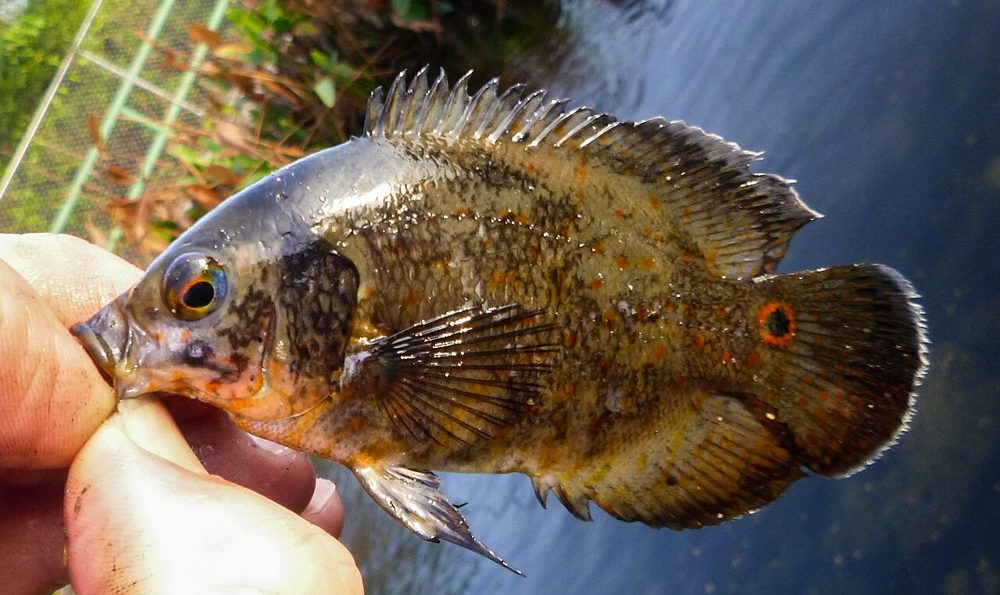
A large predatory cichlid that is not a community tank fish.
Quick facts
Oscar: how many per tank?
Maximum recommended number if it is the only species in the tank (comfortable bioload of 75%). Below 71 gal / 270 L, this species is not recommended.
In practice
A 75-gallon (284 L) tank holds about 60 gal / 227 L of real water: up to 1 can live in it if this is the only species, or 1 if you leave room for other fish.
It can live alone, which leaves more room in small tanks.
Best tank mates
This species should have a tank of its own: no species in our database makes a good tank mate.
Equipment for a 71-gallon (270 L) tank (the minimum for this species)
- Heater recommended to keep the temperature stable (68–82 °F / 20–28 °C): 250 W in a heated room, 400 W in a cold room.
- Filter: a flow of 215 to 355 GPH (810–1350 L/h, 3 to 5 times the volume per hour).
- Electricity: about $17.10 a month for the heater, filter and lights (at an indicative $0.17/kWh).
Compatibility with other species
Compared with the 52 other species in our database: temperature, pH and behaviour. Also check that your tank is big enough for each of them.
✅ Compatible (0)
No species in our database.
⚠️ Avoid (52)
- Angelfish: Oscar should live only with its own species
- Betta (Siamese fighting fish): Oscar may eat Betta (Siamese fighting fish); Oscar should live only with its own species
- Black phantom tetra: Oscar may eat Black phantom tetra; Oscar should live only with its own species
- Black skirt tetra: Oscar may eat Black skirt tetra; Oscar should live only with its own species
- Blue gourami: Oscar may eat Blue gourami; Oscar should live only with its own species
- Boeseman's rainbowfish: Oscar may eat Boeseman's rainbowfish; Oscar should live only with its own species
- Bolivian ram: Oscar may eat Bolivian ram; Oscar should live only with its own species
- Bristlenose pleco: Oscar may eat Bristlenose pleco; Oscar should live only with its own species
- Cardinal tetra: Oscar may eat Cardinal tetra; Oscar should live only with its own species
- Celestial pearl danio: Oscar may eat Celestial pearl danio; Oscar should live only with its own species
- Cherry barb: Oscar may eat Cherry barb; Oscar should live only with its own species
- Cherry shrimp: Oscar may eat Cherry shrimp; Oscar should live only with its own species
- Chili rasbora: Oscar may eat Chili rasbora; Oscar should live only with its own species
- Clown loach: Oscar should live only with its own species
- Cockatoo dwarf cichlid: Oscar may eat Cockatoo dwarf cichlid; Oscar should live only with its own species
- Common pleco: Oscar should live only with its own species
- Congo tetra: Oscar may eat Congo tetra; Oscar should live only with its own species
- Dwarf gourami: Oscar may eat Dwarf gourami; Oscar should live only with its own species
- Ember tetra: Oscar may eat Ember tetra; Oscar should live only with its own species
- Endler's livebearer: Oscar may eat Endler's livebearer; Oscar should live only with its own species
- German blue ram: Oscar may eat German blue ram; Oscar should live only with its own species
- Glowlight tetra: Oscar may eat Glowlight tetra; Oscar should live only with its own species
- Goldfish: Oscar should live only with its own species; Goldfish should live only with its own species
- Green neon tetra: Oscar may eat Green neon tetra; Oscar should live only with its own species
- Guppy: Oscar may eat Guppy; Oscar should live only with its own species
- Harlequin rasbora: Oscar may eat Harlequin rasbora; Oscar should live only with its own species
- Honey gourami: Oscar may eat Honey gourami; Oscar should live only with its own species
- Julii cory: Oscar may eat Julii cory; Oscar should live only with its own species
- Kribensis: Oscar may eat Kribensis; Oscar should live only with its own species
- Kuhli loach: Oscar may eat Kuhli loach; Oscar should live only with its own species
- Lemon tetra: Oscar may eat Lemon tetra; Oscar should live only with its own species
- Lyretail killifish: Oscar may eat Lyretail killifish; Oscar should live only with its own species
- Marbled hatchetfish: Oscar may eat Marbled hatchetfish; Oscar should live only with its own species
- Molly: Oscar may eat Molly; Oscar should live only with its own species
- Neon tetra: Oscar may eat Neon tetra; Oscar should live only with its own species
- Otocinclus: Oscar may eat Otocinclus; Oscar should live only with its own species
- Panda cory: Oscar may eat Panda cory; Oscar should live only with its own species
- Pearl danio: Oscar may eat Pearl danio; Oscar should live only with its own species
- Pearl gourami: Oscar may eat Pearl gourami; Oscar should live only with its own species
- Peppered cory: Oscar may eat Peppered cory; Oscar should live only with its own species
- Platy: Oscar may eat Platy; Oscar should live only with its own species
- Pygmy cory: Oscar may eat Pygmy cory; Oscar should live only with its own species
- Red-tailed shark: Oscar should live only with its own species
- Rosy barb: Oscar may eat Rosy barb; Oscar should live only with its own species
- Serpae tetra: Oscar may eat Serpae tetra; Oscar should live only with its own species
- Sterba's cory: Oscar may eat Sterba's cory; Oscar should live only with its own species
- Swordtail: Oscar may eat Swordtail; Oscar should live only with its own species
- Tiger barb: Oscar may eat Tiger barb; Oscar should live only with its own species
- White cloud mountain minnow: Oscar may eat White cloud mountain minnow; Oscar should live only with its own species
- Yellow lab cichlid: incompatible pH (7.7–8.6); Oscar may eat Yellow lab cichlid; Oscar should live only with its own species; Yellow lab cichlid should live only with its own species
- Zebra danio: Oscar may eat Zebra danio; Oscar should live only with its own species
- Zebra loach: Oscar may eat Zebra loach; Oscar should live only with its own species
Frequently asked questions
Oscar: how many in a 20-gallon tank?
None: this species needs at least 71 gal / 270 L.
Oscar: alone or in a group?
It can live alone, in a tank reserved for its own species.
Oscar: what temperature and pH?
Water at 68–82 °F / 20–28 °C and a pH of 6–7.5. A heater helps keep the temperature stable.
Oscar and betta (Siamese fighting fish): compatible?
No: Oscar may eat Betta (Siamese fighting fish); Oscar should live only with its own species.
Oscar and guppy: compatible?
No: Oscar may eat Guppy; Oscar should live only with its own species.